Fear of Driving

Daily writing prompt
What fears have you overcome and how?

I do not have some of the typical fears — flying, public speaking, spiders. I have a fear of heights, but I consider that perfectly reasonable, like fearing something that’s about to tear your head off. The big fear that I harbored for many years was a fear of driving a car.
Photo by neil kelly on Pexels.com

Cars are big and you can kill people with them. That was what was on my mind when I was sixteen and in driver’s ed. When I had to get behind the wheel of the car, I was a disaster. I could barely accelerate, oversteered the car, and hit the brakes too hard. Worse, I couldn’t figure out in what order I was supposed to do things, so I failed driver’s ed by stopping the car in the middle of the railroad tracks to check for trains. So I didn’t only fear being behind the wheel, I had a reason to. After a second time going through driver’s ed, I took my driver’s license test and barely passed. And then I never drove.

When I was 29, I got hit by a car, which didn’t help the fear any. All it did was break my leg, but it pretty much pulverized an inch of bone near the ankle. I now have a metal bar in that leg from knee to ankle.

A few years later, I lived in an area with a vibrant arts scene, except that the scene was spread over several towns. So one had to be able to drive to Franklin and West Kortright and maybe even Albany. I had just broken up with my husband, and the social engagement sounded nice to me. So I decided I needed to learn how to drive.

I took driver’s ed again, this time with a driver’s ed teacher who figured out the problem and helped me get over it. He made me check with him out loud anything I was about to do while driving. I talked myself through it. Then when I didn’t need to say it aloud anymore, I took my driver’s test and passed.

I got myself a car, and I was not a good driver at first. I got into a couple fender-benders, one with a rental car I had gotten while my car was in the shop. Some of the fender-benders weren’t my fault. I was suspended for 60 days for one of the accidents that wasn’t my fault. But I kept on driving.

I am still scared of driving sometimes. I am scared of driving in cities, especially with complicated splits in them. I am scared on crowded interstates. I keep seeing accidents in my head and they keep me from driving solo a lot of times. I don’t like it, but at least I can drive locally without fear.


Gang Aft Agley

(Bonus: What does the above line come from and what does it mean?)

My plan is not working

I put prompts in my calendar to remind me to write in this blog every other day and post a TikTok every other day. So far, I’m three blogging days behind, although I did my TikTok this morning, after a fashion. This self-promotion thing is not going very well.

Next to tackle — my fears

I know what’s impeding my writing — any of my writing. All of my writing, from books to blogs to Facebook posts — the fear that I’m not good enough at writing. The fear that I am, in fact, boring.

Photo by MART PRODUCTION on Pexels.com

Therefore, the block to my writing is psychological, and since I teach in a behavioral science department at the local college, this should be easy. Except that my discipline is not psychology. And I don’t do well psychoanalyzing myself. Oh, and things that hinder me erect roadblocks that make it harder to resolve them.

For example, I think I don’t write interestingly enough. In my heart, I feel it. The lack of sales/readership seems to support my feelings. I know I don’t promote enough, and I know that focusing on the bad is confirmation bias, but my mind still fixates on the failure and my suspected reasons for it.

What my psychology friends would tell me to do

I don’t consult my psychology friends at work, because 1) Most of them aren’t clinical psychologists, or psychologists who see patients; 2) It’s not cool to ask psychologists for therapy for free; and 3) I would end up with messy dual relationships — therapist AND friend? Ugly. So, truly, they would tell me to F* off if I asked. (You didn’t expect this paragraph to go like this, did you?)

But I know better, because I’ve had Therapy with a capital T, owing to the lifespan of baggage that comes from childhood trauma and bipolar disorder. And, as therapy at its best provides a set of tools one can use to manage themselves, I can go back to the learning experiences of therapy and find a tool to use with myself.

Today’s tool is called cognitive-behavioral therapy, specifically the journaling piece. The aim of the journaling is to contradict what are called cognitive distortions, which are thought processes that do not make logical sense. I will illustrate below:


Thought: “I must be a boring writer.”

What I would have said before: “You’re not a boring writer. Some people have read you. It’s just a matter of marketing. You’re really not a terrible writer.” I can counter-argue everything I just said because it’s a combination of opinion and not-very-comforting facts.

Placation doesn’t work. Try demolishing the illogical:

“I must be a boring writer.”

  • This is an all-or-nothing statement: There’s a lot between boring and best-seller. Are you saying everyone thinks you’re boring?
  • This is a mind-reading statement. How do you know how people think about your writing?
  • This statement is “awfulizing”. Is “boring” a realistic assumption regarding your writing?

Note that I’ve argued the merits of the statement this time, not perceptions of reality.

Now, I replace these thoughts with new thinking:

  • I have come a long way since I started writing and have clearly gotten better.
  • The people who haven’t read my book can’t call it boring.

And finally, a call to action:

  • I will make a promotion/marketing plan and stick to it.
  • I will continue to write.

It’s been pretty therapeutic to type this out, suggesting that I could use this more often. Maybe I’m ready to write today.

Coming on Two Years of COVID

Two years ago next week

Two years ago, it was late February and we in the United States had just started hearing of a virus called SARS-CoV-2 that was spreading through China, then Europe. As I read the Internet accounts, part of me dreaded the inevitable pandemic; another part of me became convinced that it would stay across the ocean and peter out, as other SARS infections had. Then, when it reached the coasts of the US, I still monitored the news while assuring myself it was a big city infection that would not reach the rolling hills of Northwest Missouri.

During my spring break (I teach at a university), I watched my emails to see how the university would react to the looming threat, all the while panicking at the virus creeping ever closer, a quickly advancing threat which left in its wake so many people making inexorable slides toward death, kept alive on ventilators until their bodies gave out.

Then, halfway through Spring Break, while universities hustled to continue education online as a brave new experiment, my university sent emails warning us we might follow in their footsteps. Then, a day later, we were told we had a week and a half to move all our instruction online, and that students would not come back to campus from break.

Isolation

The state’s shelter in place order fell into place, and I panicked. I hyperventilated while trying to clean our chaotic kitchen, and I worried I was having a relapse of my bipolar from all the stress. I called my psychiatrist’s nurse, and she told me many people were having the same symptoms.

So many changes bombarded us: the working from home (which didn’t affect me as I was already working from home), the precautions of shopping, the prohibition on social activities. My life shrunk to the walls and window of my living room. My husband masked up and braved the grocery stores with their six-foot distancing.

Photo by cottonbro on Pexels.com

I decided that, instead of spending all my time in a panic, I would learn to make sourdough bread with a starter I captured myself. The starter made a fine whole-wheat sourdough, and I bought 50 lbs of white whole-wheat flour because the stores were out of it.

We picked up our restaurant meals curbside, and it was not quite the same eating a steak out of styrofoam go containers.

Closer to normalcy

After a while, the shelter-in-place orders expired and my college started meeting again (with distancing guidelines). The restaurants opened up, and the stores started getting more food in stock. The mask ordinances evaporated, although my university required them and most of my colleagues and friends continued to wear them in public, as I did. Slowly, even these restrictions faded. Until this week my university has made mask-wearing suggested rather than required.

I don’t know if I’m ready to go maskless yet, given that I have been masking for so long. But when I’m free of a mask, there will be things I can do, like wear makeup and be heard in class without yelling.

A life post-COVID

I don’t know what a life post-COVID looks like. I know that, over the past couple of years, we in the US hadn’t suffered as much as other countries with crowding, with less advanced medical systems, with fewer preventative measures. But we suffered, if mostly in our day-to-day routines. And we are not done with the pandemics — another round of COVID may be in our future, or another microorganism we didn’t count on. It’s inevitable with access to other countries and terrains, where we don’t have natural immunity. Maybe I will never lose my mask, or only have it off for short periods of time. Maybe we’ll have another shelter-in-place. But what I don’t think we’ll have is a post-COVID celebration, because we’ve lived with it so long that it seems normal.

A Maskless Life

The news yesterday

When I read that the CDC had advised that vaccinated Americans need not wear masks in most circumstances, I trusted it. I decided it was time to go maskless . After all, this is the CDC, the same authority that I trusted when they told me to mask.

But at the same time

Photo by Tim Douglas on Pexels.com

After a year of masks, sanitizing surfaces, and staying away from public places, I don’t know what to think. I’ve made a habit of masking up when going out of the house, and when I forget, finding the stockpile of paper masks from the back of the car. I had been told only a month or so before that unmasked, vaccinated people could still transmit the virus. It’s not that I don’t trust the CDC — I trust science even though it doesn’t always seem consistent as it evolves. It’s just that — it’s like building up your defenses against a marauding army only to find that it has vanished in thin air.

And, against the backdrop of the new swarm of cases in India and the shelter-in-place in Canada, it seems unreal that we are demasking in the US.

Those who won’t unmask

Several people I know, serious maskers, won’t take off their masks despite the CDC advisory, even though the risk of contracting COVID is 5% or less, and the risk of dying even less (similar to those vaccinated for flu, I believe). They cite not trusting unmasked persons even though they’re immune because of the vaccine. Ironically, they’re rejecting information from the same government organization they touted previously.

The truth is, fear is stronger than rationality. The Right’s fear of losing liberty and the Left’s fear of taking off their mask are cousins. I hate to say this, because I’m a Social Democrat and tend to align with the left end of the political spectrum, but I see similarity. I also see identity expressed by the choice to wear a mask or not pre-lifting of restrictions. I see differences, too — the anti-maskers tend to operate in an individualistic form and the mask proponents in a more collectivistic vein, as they express concern for unmasked people as part of their rationale. But I see the similarities.

My choice

I will walk into the café today without a mask. I might get stares from my friends who are still masked, but I have to put my faith in the guidance from the CDC, as it’s more grounded in science than anything I could come up with. I will keep a mask in my belt pouch for crowded spaces or for doctors’ offices. I will mask again if the threat level rises, such as a new variant.

But I will choose science over fear.

Thinking About the Fear of Failure

Sorry, I’m running a bit late today

Photo by Liza Summer on Pexels.com

It’s been a busy morning. I’ve prepped four signed copies of The Kringle Conspiracy for the mail today — I have friends that want my signature. It took extra coffee to get me on task today, because I had nightmares about getting the wrong signed book in the right envelope. I swore, with that, I would complete the task first thing before I psyched myself out. Task completed; now to mail them.

Which brings me to my topic

How is it we let fear of failure get in the way of our dreams? It’s common enough that Harvard Business Review has an article on how to overcome fear of failure. So do others, but I like HBR’s version because it fits with my world view. (wise words or confirmation bias? You decide.)

Here’s their list with my musings:

  • Refine failure. This fits in with the SMART model of goal-setting. I covered the other day — goals should be attainable. I set a goal of “getting traditionally published”, and given the market, that might have been aiming too high for a first-time author. I still have that goal, but I set other goals like “self-publish one book”, and I feel satisfied with self-publishing The Kringle Conspiracy and its sequel coming out in November, Kringle in the Night.
  • Set approach rather than avoidance goals. This is the difference between “avoiding rejection” and “get published”. Or, for another dichotomy, “losing weight” vs “making healthy habits. If I accentuate failure, I start the journey to success cranky and hopeless.
  • Make a “fear list“. This is one I hadn’t heard of, and I’m going to start doing it. The technique is: 1) write what you’re afraid of, 2) write what you’ll do to keep it from happening; 3) write down what you’ll do if it happens. I’m thinking about how I might use this in my life.
  • Focus on learning. This one I love the most — because I believe my purpose in life is to always be learning. Those messy first drafts became polished novels with the help of experience. I managed to stumble through self-publishing. I’ve gotten tons of rejections, but it’s okay because I’ve learned. Success or failure, we will hopefully always learn.

The question

Drop me a line — how do you deal with favor? And which of these pieces of advice do you think will work in your life?

Day 3 Lenten Meditation: Risk


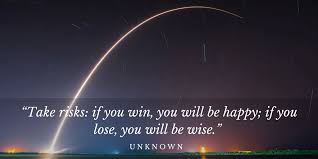
Without risk, there is no reward. There is only buckling in to the forces inside and outside of us.

Many examples of healthy, responsible risk-taking exist. Investing money for return on investment, dating, expressing one’s feelings, submitting creative works for publication, going up for a promotion. Confronting corruption and injustice, changing the status quo and being authentic also take risks.

Risk instills fear — of rejection, of failure, of loss, of negative consequences. Many people focus on the loss instead of the potential gain, and we call them risk-averse. Avoiding risk has its cost — lost opportunity, lack of progress, and a dearth of fulfillment. 

Choosing risk for its potential rewards may require changing one’s mindset with one or more of the following:

  • Examining the fear against the potential return
  • Believing that one will survive the worst case scenarios
  • Feeling the fear and taking the risk anyway 
Without risk, there is no reward. There is only buckling in to the forces inside and outside of us.

Unboxing my Dev Edit (Personal Development)


I’m a bit nervy about this …
I confess — I’ve been afraid to open up that dev edit for Whose Hearts are Mountains. It’s long, it’s detailed, and I’m going to be mortally embarassed by the mistakes I’ve made.

But it doesn’t matter.
My novel deserves an opportunity to improve. It deserves to become great, not just good. And I deserve to have a better book.

Too many excuses
I’ve been avoiding reading this for four days. I had to clean my room, take a nap, write a synopsis of a poster session I want to present research in, nap some more…

But now it’s time.
I need to get the courage to dig into it and improve the story. Anna Schmidt and Daniel Ettner deserve better than to be left in the corner, their story never heard.

Petrified

I’m going to this writers’ conference this weekend, and I’m petrified.

I shouldn’t be. I have been to many professional conferences, presented my work in front of other professionals in my field, taught 25 years of classes — but I’m petrified of going to this conference.

I can count the reasons:

  • Because now I have to admit I’m a writer
  • Because I don’t know how I come off in person
  • Because I’m going to be around real published writers, of which I’m not one
  • Because I have handed off ten pages of Prodigies in an editorial review and I don’t know what ELSE I’ll be expected to change.
  • Because I’ll be giving a verbal pitch to real people instead of just online
  • Just because 

I have no choice but to go. This is going to be a learning experience for me. Probably not my big opportunity, but a learning experience. 

Deep breath. 

Day 30 Reflection: Suffering

Suffering exists because someone’s basic needs aren’t being met. Food and water, health, safety and security — without enough of these people suffer. Suffering causes distress — fear, anguish, pain. 

Society holds onto a narrative that paints suffering as ennobling. We admire the hungry villagers, the mentally tortured artist, the once-vibrant person dying of cancer. 

We should admire people’s resilience in the face of suffering, but we should not dismiss their suffering as ennobling. We should instead do the humane thing — see what we can do to help reduce their suffering. It may be that we can provide simple help like food and drink. Maybe we work to dismantle unjust structures that cause people to suffer, like reducing racial bias in policing. Even companionship, understanding, and acceptance may be enough to ease suffering.

Suffering is not noble, but weathering it together may be.


Day 28 Reflection: Wisdom

We are told that our elders hold wisdom (and having just reached AARP age, I certainly hope so). But at the same time, as people get older, many become more resistant to change. 

We are told that wisdom comes from experience, but some people learn nothing from their experiences.

How do we discern wisdom, then?

Wisdom doesn’t bubble up out of fear or anger, although fear or anger may make us reach for wisdom. It rises from the still pool at the center of our being.  It may goad us to act or ask us to wait, but it does so with a sense of what has gone before and a great deliberation. The answer it gives is grounded in humankind’s best nature, deep in understanding.

Do not mistake wisdom with the resignation of “things have always been this way”, or the self-righteousness of “things have always been this way”. Wisdom is not about preserving or giving to the past. Wisdom is about learning from the past and using it for advancing a life, a people, a world into its future.