
I tried to do nothing
Today I was supposed to do nothing. Instead, I revised two query cover letters and submitted two novels and two stories on Submittable.
Then I lazed around
So it’s okay; I got some rest.
Today I was supposed to do nothing. Instead, I revised two query cover letters and submitted two novels and two stories on Submittable.
So it’s okay; I got some rest.
My mind is simultaneously antsy and lazy — I should be DOING something! I have an exam to grade! I could be creating advertising materials for my book! I should be — my brain can’t focus. I feel like laying in my bed all day watching House episodes on my phone.
I understand the tired part — I just got off a full semester without any Spring Break, after a year of severely restricted activity due to COVID. I made it without more than one or two sick or mental health days all year (due to the ability to teach over Zoom). With finals all that are left, I find myself slumping my shoulders and relaxing.
It occurs to me that the antsy part is the craving for flow. Flow is a psychological concept that refers to the state of being completely captivated in an activity that uses your abilities at an optimal level. Writing is a flow activity for me, as is editing. Designing (with my limited abilities) is another. Most of my flow activities happen at a computer and fit in with my writing, which is probably why I write.
No challenge is optimal when I’m just coming off a brain-numbing school year. I’ve been challenged out. I’m still dealing with three exams to grade this week and unhappy students.
Another part of my always needing to do something is the feeling of satisfaction I get from accomplishment. I delight in making things happen. I love finishing a chapter, a novel, a cover letter. I get motivated by the finished product as well as the process (the flow). Again, my mind is having none of that.
This is a time where perhaps doing nothing (or next to nothing) would be the best thing to do. It’s hard for me to do, because I’m always trying to wrap myself in flow activities and completing projects when I’m not working. Although I’m addicted to flow and accomplishment, maybe I could use something more relaxing but inspiring like daydreaming or meditating. Or maybe I should just read reruns of House and see if I can diagnose those disorders.
I have spent my life developing “project obsessions” where I completely immerse in a hobby and then, inexplicably, give it up. I hit a moderate level of proficiency, and then I get stuck, and then I give up. I did this with embroidery, beadwork, gardening (I couldn’t keep up with the weeds and my gardens didn’t look beautiful. I hit the wall.
Writing has been an exception. I have been writing for — six? seven? years, and I don’t seem to be ready to stop. I learn, and I improve, and I don’t seem to hit the wall. I’m not sure why; possibly because it doesn’t take hand-eye coordination (which I’m severely lacking) or lots of money (which I don’t have). Writing for me is at the optimal level of challenge with opportunity to improve.
With writing goals. it’s best to set internal goals. I’ve made the mistake of setting the goal of getting traditionally published which is an external goal I have little control over, especially in the overloaded publishing market. If I set internal goals, I’m much more motivated. Not that I’ve given up being traditionally published; I’ve just decided that I have to set it as a secondary goal.
I guess writing is with me as a part of my life.
I am really balking on Gaia’s Hands again. Enough that I would rather work putting together my spring semester classes today than write on it.
I think the real problem is that it’s not writing from scratch; it’s working in already written parts to the story. In other words, it’s not a flow activity. And flow activities are where it’s at, according to positive psychology.
As I’ve discussed in the pages previously, flow is a concept that’s related to happiness. Flow is the experience of satisfaction, challenge, and timelessness one feels when one is in the “zone”, which happens when performing a task where one can focus and where one has the optimal level of challenge and engagement. Too simple a task, and one gets bored; too difficult a task, and one gets frustrated.
When I was writing Kringle in the Dark, writing was a flow activity. I could write 2000 words at a sitting; it was even more of a flow activity when I went on word sprints (timed writing activities) — 20 minutes at a time of just writing.
Gaia’s Hands is just work right now — the old plot warring with what might be the new plot, old parts needing to be revised, etc. The story has been a problem child since I wrote it, and I hope that this iteration will be the winner. But it’s hard, which is the enemy of flow.
Maybe I’ll write on my class sites after all.
I’m happiest when I have something to work on, something that catches my fancy. When that happens, I can give it intense focus such that I float within the bubble of my attention and time flies by without me.
This, in the psychological literature, is called flow. Flow takes a person out of time and place, and becomes almost a type of meditation. It requires tasks that one is competent yet challenged in. Flow is good for creating happiness.
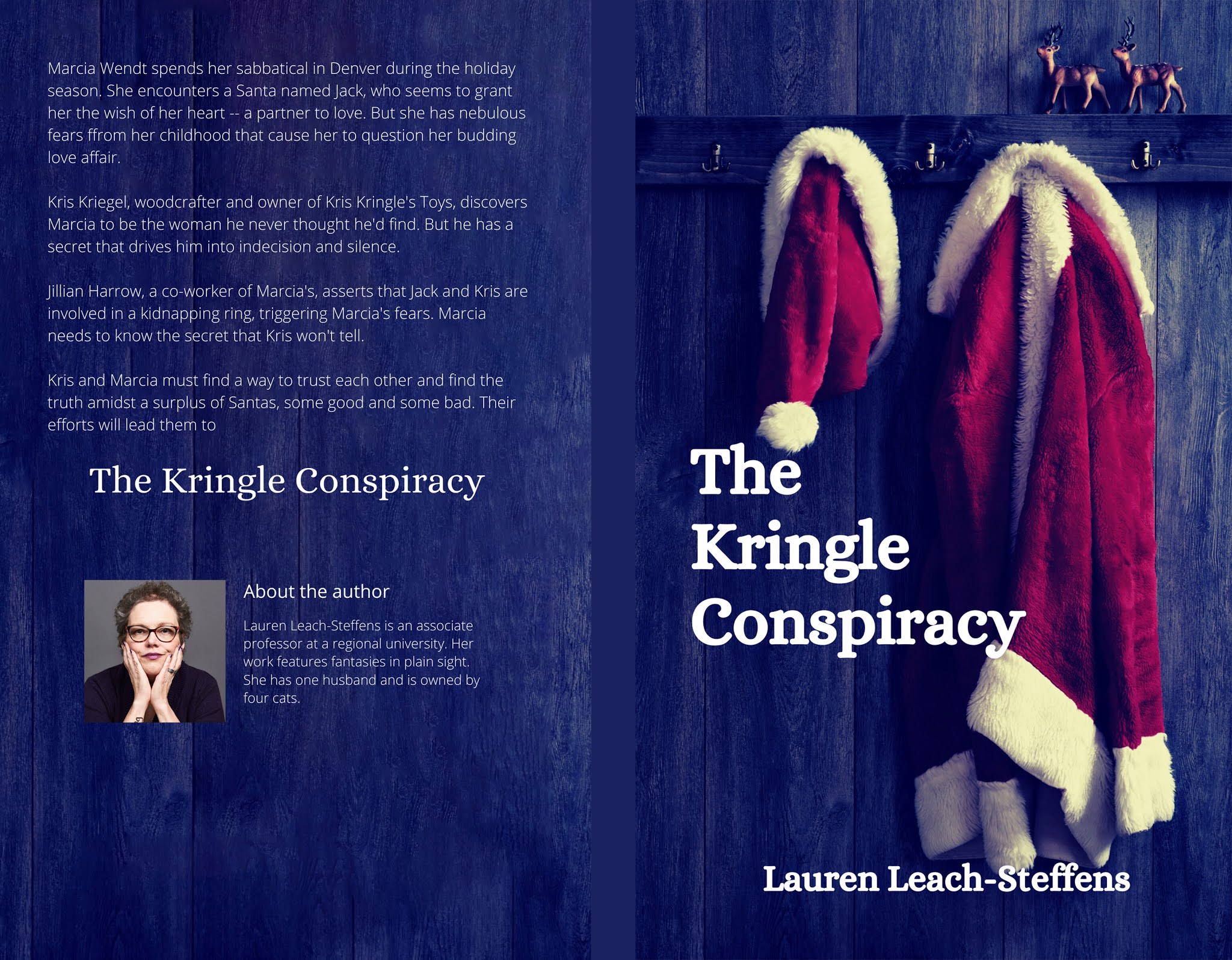
I’ve been creating book covers (both e-book and traditional) for The Kringle Conspiracy, which (depending on whether I feel it needs a dev edit) will be coming out in time for Santa. My favorite beta reader (Hi Sheri!) is on it, and my husband has already given it a good look through. Because it’s so short and so simple for something I write, it may be ready. In the meantime, the cover is ready.
So designing that cover gave me flow. What else gives me flow? Writing, at least in the drafting stage. Reading. Sometimes teaching, but not lately with all the equipment I have to sling around.
It’s important to have flow, to take one away from worries and stress (like COVID) and the like.
What are your flow activities?
Questions I ask myself while writing:
I feel discouraged looking at all these questions — how can I manage to do all this? Much of this happens subconsciously, or by trial and error. Sometimes it’s hard, because I don’t (obviously) write the whole book at once, but by bits and pieces. A lot of this I miss with my own tired eyes, which is why I have a dev editor and I let others read my stories.
So in actuality, it’s a matter of trusting myself, trusting the process, and just writing.
So I made my summer schedule nice and neat — only to have to revise it already.
Rain, of course. A visit to the acute care clinic. Best intentions gone to hell.
I wonder if my schedule’s too strict. I wonder if it’s just me being reluctant to follow a schedule. At any rate, the flow is not happening.
I’m second-guessing my schedule just like I’m second-guessing my editing.
I’m editing the bulk of Apocalypse, trying to cut out what isn’t necessary, and I’m struggling between “burn it to the ground” and “I can’t kill my darlings!” Some good quality time writing should solve that quickly — or perhaps slowly. If I get the hang of what should stay and what should go, I should be done by June 1 because the story has good bones.
I guess the motto is to try for excellence and not perfection. Perfection has me chasing my tail and getting nothing done.
Flow doesn’t happen when I’m nitpicking details.
 |
| Welcome to the Hotel Atlantica. Cots optional. |
Another day in Atlantica. We had our first round of beans and rice, supplemented by Cuban pork to weep for, with crackling skin and deep flavor. We will likely eat beans and rice without it tonight. Remember us as you drink your coffee — It’s 6 AM and there’s no coffee to be seen. And we have no way to get out of Atlantica.
No, Atlantic Hope is still some of the most fun I have all year. The people who volunteer to run the show are emergency personnel from various ares — one Brigadier General, a retired Navy Seal, nurses, humanitarian aid workers, firefighters, security personnel — and me, a pacifist who feels uneasy when people talk about their weapons like beloved racehorses. But they need us, because they don’t think they have the talent to do casualty simulation or, perhaps think it’s not as important as what they do. It is, after all, makeup, which is girly stuff.
I don’t really know if I have as much talent as they think I do. Richard and I get geeeted regularly during the exercise with “Really love your work!” We’re self-taught. Richard studied under me. I,d love to get more training but most of it is driven by the various companies who make Moulage products. We are not makeup artists.
But I’m here, and they need me, and when I’m in the flow of creativity, none of the above matters. I’m here doing something I love.
*******
Twenty-seven days left, and it already looks bleak for my campaign. Thank you if you’ve nominated me; 357 nominations is more than I thought, and less than I need. It seems a brutal way of getting discovered, though, and I know I may not be writing what people want to read, but thank you. https://kindlescout.amazon.com/p/250Q7OJ0R0F8W
Caution: My day job is a Human Services professor, and I teach a positive psychology course. Classroom lectures come out of my mouth (figuratively and literally) at the most unusual times.
According to the psychologist Mihaly Csikszentmihalyi (1990),
“The best moments in our lives are not the passive, receptive, relaxing
times… The best moments usually occur if a person’s body or mind is
stretched to its limits in a voluntary effort to accomplish something
difficult and worthwhile.” (Csikszentmihalyi, M., 1990)
The quote above refers to a concept called flow. In flow, sense of time is lost and all that remains is oneself and one’s skill and the challenge. Flow becomes a source of well-being.
If you have a creative life, you have probably experienced flow. The night on the stage where you become the character; the dance where you merge with the music, the rhythm of your feet on the floor, the movement of your partner; the writing session where time passes without your notice and you’ve captured the moment you’re writing about.
(I do not mean to imply that flow only comes from creative endeavor — people with noncreative talent experience flow as well — repairing a car engine, cross-stitching a sampler, or teaching a class.)
I think creatives, having experienced flow in our creative lives, crave it over and over — and do not always find it. Dancers have days where they miss their landings, where every movement is effort without reward. Actors have days where they’re handed a new script and they can’t encompass the character even if they’re Method and have literally put themselves in the character’s shoes.
Writers have those days when they can’t motivate to write, because we look at what we’ve written and the characters don’t shine or threaten, because we’ve lost the thread in the side plots, because the plot that looked iron-clad has a hole the size of a small house, because we had to go back to doing research (that pierogi place in Krakow haunts me in my dreams). Trust me, I know, because I’ve dealt with all these lately.
These will pass. Because we’ve paid our dues and found a level of proficiency that allows us flow, we will find it again when we hone our abilities, regain our focus, and pursue excellence.
Oh gosh — I discovered a new wrinkle for the world I’m writing in, and it’s about flow:
So I have prodigies with “normal” talents who also have talents in less normal categories, talents that can be “weaponized” — emotional manipulation, perfect recall, fire-starting, etc. These shadow talents are not always available — could it be because the shadow-talents are fueled by flow?
 Words Like Me