Trying for Another Book

So I’m writing a new book, or at least I think I am. I’ve gotten past the layout (which I will revise, I’m sure) and into the actual writing. I have gotten one chapter written and already I find myself out of ideas at the moment. It’s the part of the book where the writer sets up the premise and I already feel like I have that sewn up. And there are three more chapters to develop the premise. I hate when that happens.

I use a template when writing because I feel somewhat impaired by linear storytelling. There is an expectation of when things are supposed to happen in a book, and a template helps with that. For example, in the next part of the book, there’s supposed to be a debate over the future action in the plot: “You should not do the thing.” “Why should I not do the thing?” “Bad things will happen if you do the thing.” (And the protagonist does the thing, and everything goes wrong, and the protagonist’s hubris gets them killed. This is known as a tragedy. I don’t write tragedies. Yet.)

By the end of this book, the intrepid protagonists will gather together, fight against the Council of the Oldest who are trying to keep them from congregating, and start a commune in the desert of Nevada. I hope that’s enough plot to keep the book going. The problem with this story is that it’s writing out a historical event I know happens to my protagonists, but I don’t know if there’s enough there to write. Wish me luck; I need to get some writing in.

Photo by Lisa from Pexels on Pexels.com

Pantsing

Photo by Thirdman on Pexels.com

Pantsing refers to a style of writing whereas one makes the story up as they go along. It’s part of the trinity of methods, the other two of which are planning and plantsing. Planning the story is just what it sounds like — from using an outline of each chapter to setting up scenes and documented world-building. Plantsing is somewhere between the chaos of making it up spontaneously and organizing everything.

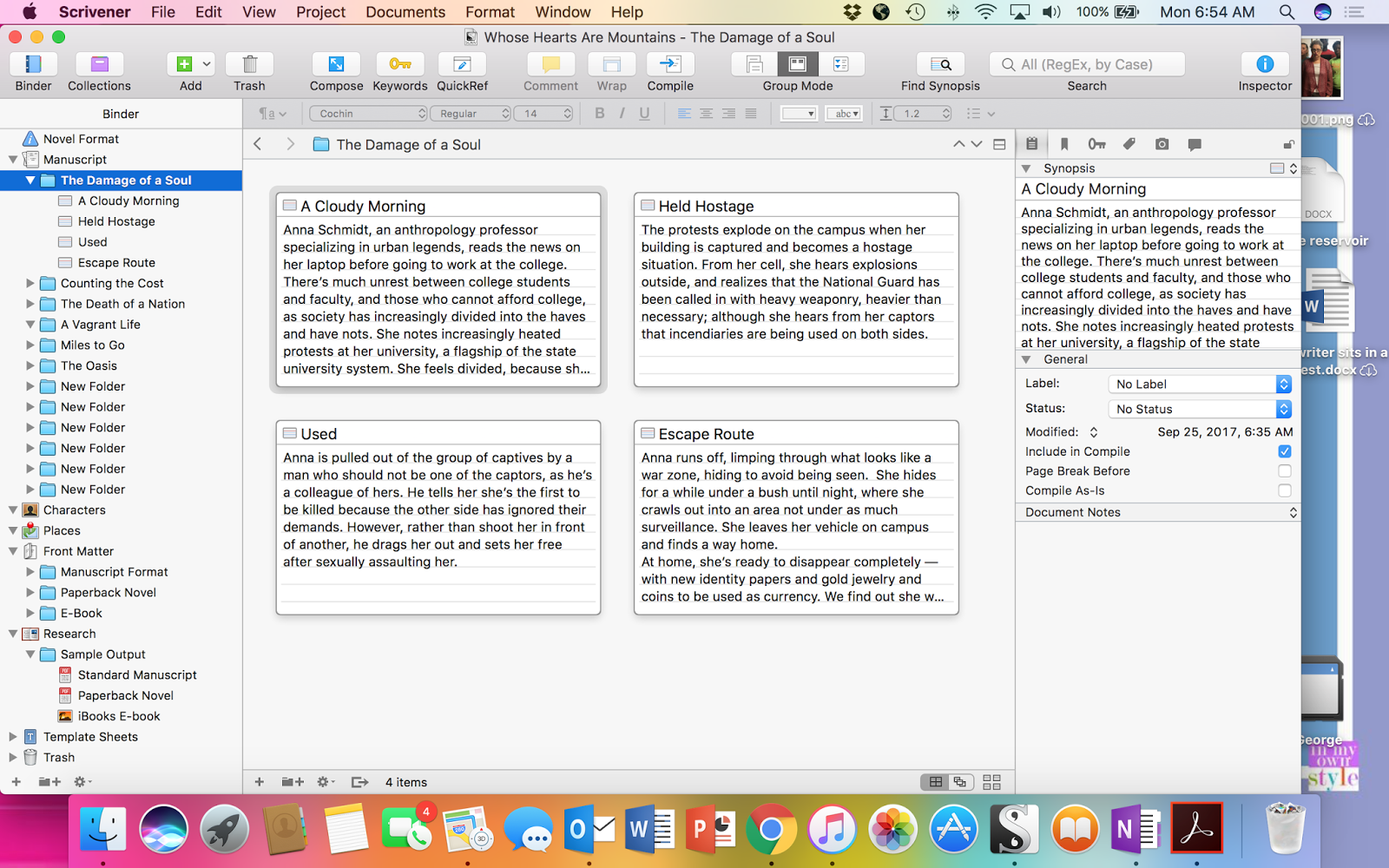
Normally I am a plantser — I have “note cards” (a feature on Scrivener, the program I recommend for writing novels) for each chapter denoting what should happen in the chapter, and I see where those directions and the characters take me. But this time around, I have diverged from the note cards enough that I am most definitely pantsing.

For example, I was writing about how my characters in their collective (think commune, sort of) were going to cope with the potential for communications and shipping breakdown in the oncoming breakdown of American society, and I thought about replacement parts and fuel for the farm. While I was in the middle of writing that, I thought, “Oh my god, what are they going to do about the staple goods they don’t grow themselves?” The collective eats a certain amount of bread, for example, but they don’t raise the wheat themselves because only the wrong type of wheat grows in the Midwest. In addition, they’re vegetarian and bought rather than grew their legumes. They use their farm land for more suitable items for the collective, like fresh fruits and vegetables, as they could always buy the staples through the local food co-op. So they suddenly figured out they could have a food crisis. In striving to be self-sufficient, they blinded themselves to the fact that they were not self-sufficient, any more than other humans. They discovered this at the same point where I thought about it, of course.

I may edit this later, putting the food crisis before the capital goods crisis chronologically. But I may not, because if it occurred to me in that order, maybe it would have occurred to them in that order. Maybe the capital goods crisis they envisioned was the one the collective saw most clearly* and therefore first. Part of the process of pantsing is the harder job of editing down the line.

Photo by u0410u043du043du0430 u0420u044bu0436u043au043eu0432u0430 on Pexels.com

It’s been a wild ride writing this novel so far. I feel like I’m climbing a rock wall without a belayer. If I felt a lot better about my rock climbing skills, I would not feel like I needed belaying.** Ah, well. See you at the edit.


* This is known in cognitive psychology as the availability heuristic, whereas we believe the most readily imagined scenario is the most likely or important one. This heuristic is why young people buy life insurance and not disability insurance despite being 7 times more likely to die than to become disabled.

** I just about used the word ‘balayage’ here, which is a hair-dyeing technique. Oops.

The Beginnings of a Novel

The outline for the new book is going very slowly …

Let me explain the general idea of the book. This is in the Archetype series, none of which has gone to developmental edit yet. A little background: Archetypes are near-immortal beings who are tasked with holding humanity’s cultural memories. If the Archetype for an ethnicity dies, all of the people whose patterns they hold die, so that an entire ethnic group (and, more likely, a large group of people of mixed ethnicity that includes that group) die.  This is why Archetypes have been held apart from humans and each other.

My series covers the interactions between one particular renegade family (unique in that Archetypes don’t generally have family bonds) and humans. The humans have their own uniqueness in that they have been gifted with abilities by (depending on who you ask) Gaia, the Maker of the Archetypes, God, or genetic enhancement.

The story I’m writing, tentatively called Gods’ Seeds, involves two threads that will come together as the story develops. But here’s a first attempt at synopsis:

The Council of the Oldest, the ruling body of the Archetypes, has announced that humans’ genetic and cultural memories will be gradually divested back to their humans, as humans have been found fit to retain them. Meanwhile, a young woman on Earth named Leah Inhofer sees horrific visions of Archetypes battling each other, with thousands of human casualties resulting. The Archetypes grow restless, knowing that their reason for existence is being taken away, and they will take desperate measures to keep this from happening. The conflict draws battle lines between Archetype and Archetype, and Leah must find the strength to stand between the two — or watch the decimation of humanity.

****

There’s a lot of writing in-between this paragraph and a novel. There’s character, there’s subplots, there’s relationships between characters. And there’s a lot of words — about 80,000 words on average. That’s why I’m going to write an outline, to help me find my way through the plot of the novel.

Wish me luck, and let me know if you’d read this novel!

Prepping the Next Story Part 1

I will be writing for NaNoWriMo this November. I think I explained this phenomenon before, so jump to the next paragraph if you’ve read this before: NaNoWriMo is a worldwide writing committment, where the participants commit to 50,000 words — which is well on the way to finishing a novel. In thirty days, 50,000 words equals 1,667 a day.

I started participating in  NaNoWriMo because I’ve been known to easily abandon hobbies and free time activities. It runs in the family — my mother had an attic full of bolts of material, often purchased on sale, and scraps of velveteen and brocade that she planned to use someday for a Project. Mom’s projects, like mine, were never small,  and like me, Mom expected to start a project at expert status. As an illustration, the scrapbook for my wedding sits unfinished, and Richard and I just celebrated our tenth anniversary.

NaNo changed that for me — primarily because it gave me a Big Audacious Goal. I could say “I’m going to write a 50,000 word book” to my friends and they’d say “OOOOH!” And then, having committed to the goal, I had to actually write it to save face. And then, at the end of the month, I had a book I had to take seriously and start learning how to edit — that, as you know, has taken a while. And now I have the discipline to write over and over.

This year for NaNo, I’m going to start writing the “dirty commie gypsy elves” book that I’d conceptualized twenty-five or so years ago, which has neither gypsies or elves, nor are they dirty.
How do I start?

I’ve done this before — I start with a loose outline of major plot events, which looks like this:

On the left-hand side at the top is the outline for the book. I have the chapters added, with six titled, and the first chapter with its subchapters named and visible. The cards in the middle are the synopses for each section.  There are some commands at the right I will set up later.

That’s what I will be doing for the next couple of days, so that my book has some time to percolate in my mind in October after I edit another book.   Wheeeeeeee!