Do Nothing

I want to do nothing today. Absolutely nothing. I want to store up the nothingness so that when I go through my busy week, I feel rested and open to whatever the week throws at me.

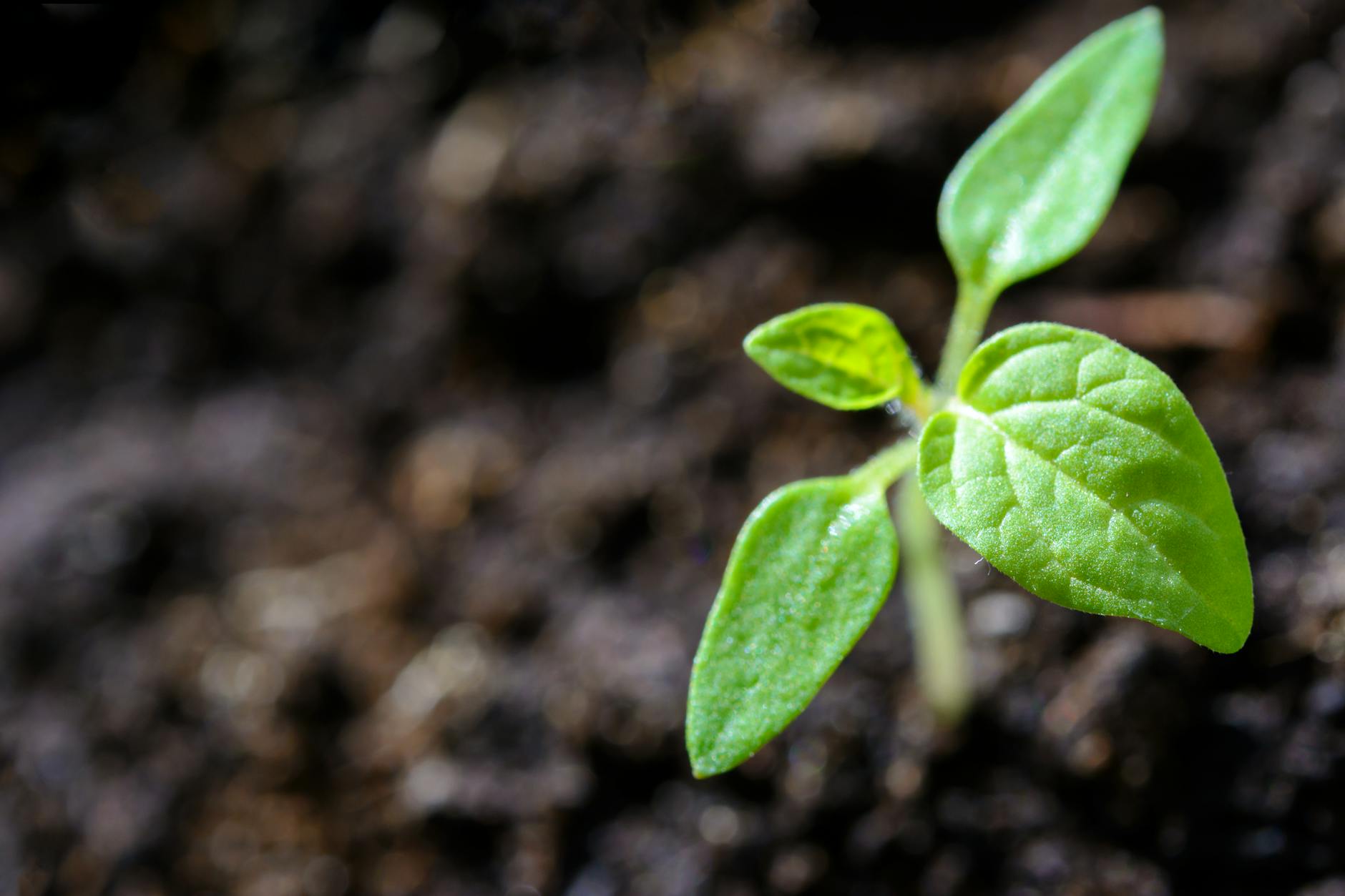
Photo by Ihsan Adityawarman on Pexels.com

It’s hard for me to do nothing. I will end up doing something, even if it’s reading Quora all day (a waste of time; I would probably accomplish more by napping). I will check on the plants in the basement and, if I feel bored enough, I will possibly write. That’s the only thing that gets me writing these days — absolute boredom, and my writing is desultory and not flowing.

If it were possible to store up sleep, I would take a nap. But napping will keep me awake at night, and I can’t afford to miss my lifetime sleep.

I will end up emulating the example of my cats, who do nothing for hours a day. Right now, Chloe is laying on the arm of my chair, cuddling up against me. I could certainly do worse.

My Seedlings

I might have mentioned before that I have a grow room in my basement to coax seeds into seedlings for the garden. I planted some early seeds on the second of February, and most of them have shown at least a little growth. I have cardoon (a relative of artichoke, except you eat the leaf stalks), mountain mint, yarrow, hyssop, lovage, lavender, and rosemary in a 72-cell seedling tray.

The lavender and rosemary are going very slowly, but both have at least one seedling up. The cardoon might need to be transplanted sooner rather than later because it’s big. I didn’t think the cardoon would come up so soon because I’ve had such bad luck with it before, but no, it popped up like the alarm clock had just gone off.

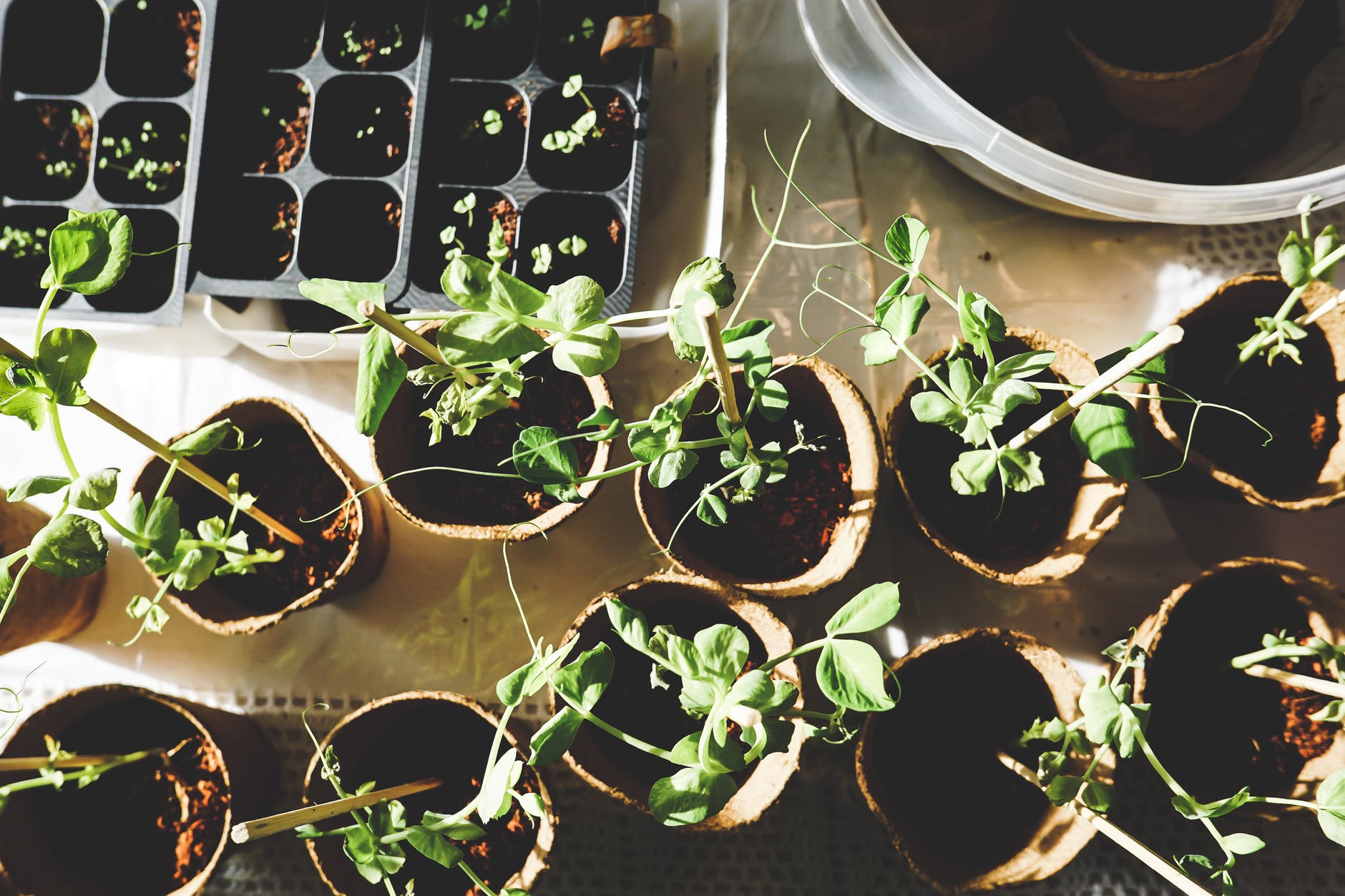
Photo by AS Photography on Pexels.com

Growing seedlings helps me through a cold winter. Whether it’s the thrill of growing green things, the brightness of a room full of fluorescent grow bulbs, or the reminder that Spring will eventually arrive, it’s one of the best things for the winter blahs I’ve done.

One thing that worries me, though, is that I’m not writing. I’m burned out on writing, and have a lot of doubt about how good my writing is. But at least I have a hobby to sustain me.

Writing and Growing

I am going back to my garden preparation after a couple of years of sitting out. I’m also going to keep writing if inspiration hits me (which I hope it does soon) and promoting my books on social media. And of course, work my day job (professoring). I’m going to over-commit myself, apparently.

Photo by . u2583 on Pexels.com

I’m buying seeds, which is followed by cleaning my grow room and organizing planting times. Today I’ll organize planting times; later, I’ll make my husband clean the grow room. (I know that using the phrase “grow room” makes it sound like I’m growing an illegal crop, but I assure you I’m growing strictly legal eggplant.)

My strategy here is that, if I remove my focus from writing, I will find the inspiration to write something new. This has happened to me in the past, usually when I’m at my busiest time at work. It’s uncanny how often it works.

And maybe if I put my focus on writing, Richard and I will weed the garden more. I know I’m being overly optimistic. We’ll see.

Some of My Other Hobbies

What is there besides cats, coffee, and writing?

That’s a good question, because I write about these all the time. But there are other things that interest me, sometimes to the point of fascination.

Plants

I have a fascination with plants, especially edible ones. And poisonous ones. I can now determine between Queen Anne’s Lace (not deadly) and poison hemlock (deadly). Not that I’ll be eating either, but Queen Anne’s Lace is, in effect, a wild carrot. I don’t try to identify mushrooms, because they all look the same to me.

I like to know plant names, because to just dismiss weeds as “weeds” eliminates a world of useful plants. Everything from lamb’s quarters (as good as spinach) to jewelweed (soothes the sting of nettles). For that matter, nettles (once cooked, a nutritious soup green.

This knowledge of plants helps me write. For example, I almost killed off a character with ricin from the castor bean plant. Writers often joke about their search histories; I am no exception.

Bread baking

I guess this goes along with plants, because yeast is a plant. I was never more aware of this as when I created my own starter by capture. This method depends on wild yeasts in one’s environment and making a hospitable medium to make them flourish. I kept these going for three months last year during the lockdown, until I realized we would never make enough bread. There is no true sourdough bread recipe for the bread machine. I have my cultures dried and frozen, however, to be started back up soon.

Cooking

I don’t cook often these days, but I am an accomplished cook with some training in food science, menu planning, and nutrition. I also cooked for two years in a Thai cafeteria, and we cooked more traditional recipes for ourselves, so I learned the basics of Thai food and now can navigate around a Thai recipe with ease. I make a mean Kung Pao chicken and Thousand-Year (master) sauce. I’m teaching my half-Chinese husband how to make Asian food.

Reading

Of course, reading. My favorites are fantasy and science fiction, but occasionally I’ll read Regency romance and the JD Robb series in crime romance. I should read more, but writing and my day job keep me busy.

Bird-watching

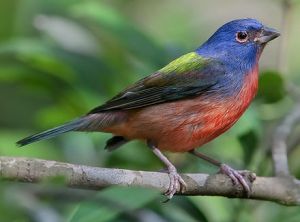
I haven’t gotten out to a good natural setting for a while, so I haven’t seen any new birds lately. I think it was two years ago I saw one of the birds unexpectedly on my life list: A painted bunting in southeast Kansas. I’m too lackadaisical to be a great birder; I’m just excited when I see a bird I haven’t seen before.

For you

What are your favorite hobbies? Tell me about them!

My Sanctum

As I have mentioned before, one of the things that saves me from severe winter blahs (aka Seasonal Affective Disorder) is my planning for the spring garden. 

I should explain that my garden has rules: everything I plant in it should be, at least in part, edible*. This means that I landscape with edible flowers, herbs, and plants that have been gathered and eaten in American or other cultures. Most of these can’t be found in nurseries or are rather expensive if bought as plants, so I grow them from seed myself in my grow room.**

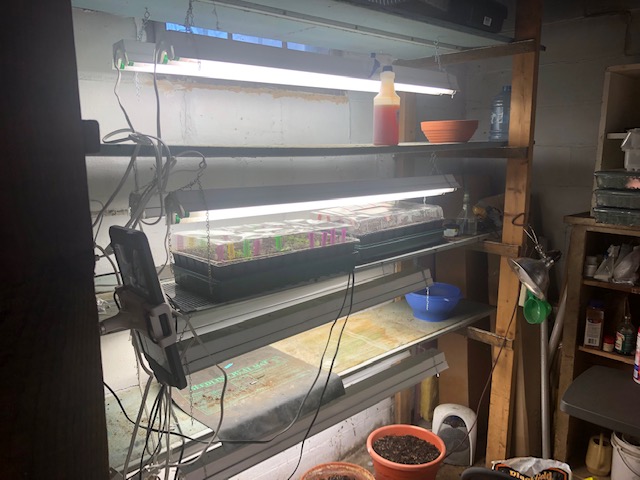
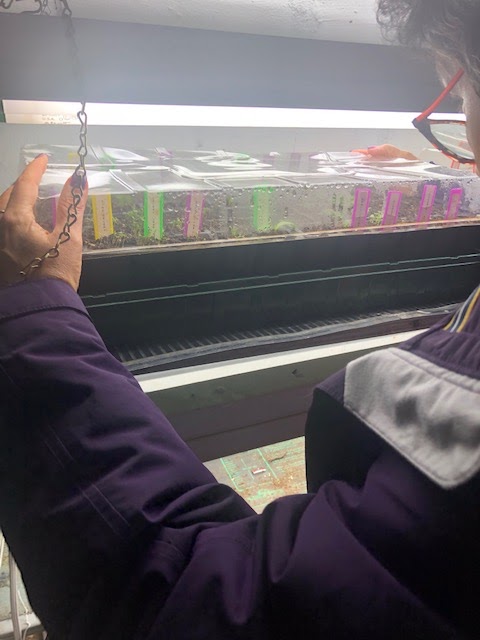
 Here is a view of my grow room, which is a small basement room that used to be the coal room back when my 100-year-old house was a youngster: 

Not very impressive, is it?


The wires are for all the fluorescent fixtures and the heat pads — and the ancient iPad repurposed for record keeping that you see at your left.  The wall that you can’t see is lined with reflective material that was meant to insulate a garage door. Peel and stick — excellent for increasing the light in this room.

The flats you see are for two sets of items I’m growing — the edible nightshades (tomatoes, peppers, eggplant) and a handful of herbs (celery, lovage, yarrow, calamint, perilla, hyssop, alpine basil herb).

Closeup of my first herb flat

I have more to plant — I’m waiting on seeds for my moon garden and more herbs and for some flowers (and for lots of things that will get planted directly in the garden. By the time I’m done, I will have six to eight flats of seedlings to nurture.

Not all of them will survive. Past seedlings have succumbed to damping off disease (which I fight heroically with cinnamon water spray) and watering malfunctions. Some seeds never come up. On the other hand, sometimes they grow faster than I expected, which is why I’m setting the top shelf (that you don’t see) for taller seedlings to reside. I will save the best of the plants that come up for planting come spring.***

Spring comes to me sooner than to most because of my grow room, with its ugly cement floor and worn shelves. Today I sat with my seedlings, thinning them out so that they could grow strong, and feeling, if not happy, a bit less out-of-sorts.

* This year’s exception is the moon garden, which is comprised of white, night-scented flowers, most of which are toxic to deadly if eaten.

** When I say “grow room”, people think I’ve got one of these high-tech setups advertised on eBay where people grow — well, plants that are illegal to possess or use in this state. Mine is not nearly so exciting.

*** This doesn’t count the direct-seeded vegetables. I have to admit that I’m not as good with these because it gets too hot to weed and there are so many weeds. I’m working on using more mulching and earlier morning weeding.

Besides writing and moulage in my life, there’s gardening.

I dream of the first emerging sprouts speaking to me.

The stretch of the first seedling breaking through the soil with the tiniest pop assures me that change is possible. And each seedling, each plant, has purpose. The lowliest weed has purpose —  dandelion makes a wine whose pale nectar will break your heart. The scrubby lamb’s quarters tastes better than spinach, and purslane is rich in Vitamin A and Omega-3 fatty acids. What is toxic to man may treat your illnesses — the toxic foxglove can be processed into digitalis, a heart medicine that you might have heard of. Even the otherwise useless Cannabis sativa* is a bioaccumulator, pulling heavy metals from the ground and sequestering it in its leaves.

My basement is full of seedlings to go into my summer garden. They live in the former coal room, now a room of grow lights and reflective insulation material on the far wall, with a window that the law enforcement officials can look at and make sure I’m growing tomatoes. This may not be enough.**

Right now, the tomato/eggplant/pepper plants are partying on the top shelf with the cardoon which I thought I wouldn’t get to grow. The perilla seedlings are numerous and vigorous. Hablitzia, yarrow, pinks, and savory are popping up a little more leisurely, and I still can’t get sea kale to grow from seed. The basil — I’m a basil fanatic, but I still may have to give some away. That’s not all the seed flats — I am nearly out of room on my plant shelves, and there’s a dwarf lemon tree I hope gives me lemons for lemonade someday.

At night, when I go to bed, I imagine I hear the plants sighing in their sleep. When I feel down, I contemplate sneaking down to the basement and joining them in the dark. But I am human, and cannot sleep in a garden bed, so I wish them a silent goodnight.

***********
I’ve gardened since I was about five years old, when my second cousin Dale Hollenbeck gave me a plant of his that was dying to see if I could nurse it back to health. I did, and I did the next one he gave me. I had a lot of failures, largely because of my lack of understanding about soils — it turned out that Illinois’ hardpan soil wasn’t a great planting medium for cacti — or much else. It was at that point that I wanted to learn anything I could about plants.

My neighbor Johnny Belletini, who was somewhat of an adopted grandparent (I adopted him), taught me one day that weeds weren’t nameless and had uses people didn’t know about anymore. I was fifteen; he taught my his recipes for dandelion greens and dandelion wine that day, and I made my parents leave the lawn unmowed until I picked all the flowers to make dandelion wine***.  We did everything wrong, but the result (don’t ask me how I know) was a sacrament, sunshine in a glass.

When I was seventeen, my second cousin Francis Koenig**** worked in a state park for a while and had an encyclopedic knowledge of those previously nameless weeds. At the time, I had begun my lifelong interest in edible plants. He would visit me at my parents’ house, and my family would sit mystified as he and I talked about plants — their genus and species names, appearance, habitat, and uses.

Nowadays, I have an odd quest, and that is to landscape my entire yard with edibles. I have raised beds for annual vegetables and for perennials, I will add edible weeds (tastes like spinach) like quinoa and orach and giant lamb’s quarters, and I will add herbs to the rubble-and-dirt hill by the stairs to the backyard.

Many of the edible plants I’ve never eaten before. The moringa thicket in a pot in the basement apparently has excellent nutrition for a green tree, and the scarlet runner beans are a favorite in Britain. But I’m fascinated by vegetables and fruit that can’t be found in a grocery store, just as I am interested in people and places you couldn’t find near a shopping mall.

Later this spring, I’ll give you a virtual tour of my garden (if I can get my SketchUp software running on a four-year-old Mac with no graphics capability to speak of. If you want pictures, let me know.

Thanks for keeping me company.

******************

* I do recognize that C. sativa is not useless; I was just having a little fun. The plant has proven useful for wasting syndrome PTSD, chronic pain, muscle pain, glaucoma, and mental health issues. (Grinspoon, 2018). In addition, it is used as a sacrament in the Rastafari religion.

** There is also a window where any curious law enforcement officer can look into to assure themselves that there is no Cannabis grow operation here. I still feel a certain sense of unease about having a grow room in my basement. I’m not kidding. Not Marijuana

*** I made my first batch of wine at age 15. I did my research first — although there was a law against drinking until age 21, there was no law against making wine at any age unless you made over 200 gallons a year and/or sold it.

**** Francis Koenig died of drowning in 2009. I point this out where I otherwise would have because 1) he was family and 2) he lived lonely because of his neurodiversity. I believe he was on the autism spectrum, as he worked at a sheltered workshop until he retired. I want you all to see that the neurodiverse have lives and feelings and deserve to be members of society to the extent they feel they can. Thank you, Francis, for telling me that hawkweed had edible roots — I look for it often, and I think of you.

************

Grinspoon, P. (2018). Medical marijuana. Available: https://www.health.harvard.edu/blog/medical-marijuana-2018011513085. [March 13. 2018].