
I think I have the flu. You don’t need to care; I just don’t to break my 84-day writing streak on WordPress.
Tag: writing
Book Promotion Time

I haven’t promoted my works lately. I’ve read somewhere (I don’t remember where) that I should be promoting my work 1/3 of the time, but that would be twice a week and I think that might be a bit excessive. On the other hand, I hardly ever promote my work.
The first book I want to promote is Kringle Through the Snow, which will be coming out on Kindle October 1st. It’s a Christmas romance in the Kringle Chronicles series. Self-professed nerd Wade Nelson meets high-energy event planner Sierra DuBois, and they struggle through Sierra’s abrupt goodbye. It will take soul-searching and a bit of Santa magic for them to find their happiness together.
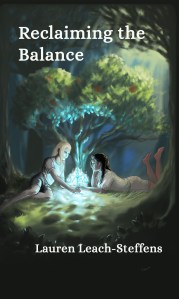
The second book I want to promote will be arriving January 1, 2025 on Kindle, the third in the Hidden in Plain Sight series. In Reclaiming the Balance, sculptor Janice Wilkens escapes her abusive boyfriend to alarming news at the ecocollective Barn Swallows’ Dance. There, she meets the androgynous half-human Amarel Stein, who helps her accept that her son is likewise non-human. Janice’s ex wants her back to father more soldiers on, and Amarel and Janice must fight back and rescue Janice’s son from his captivity. Amarel and Janice will have to reconcile their differences to find the way to each other.
There are other books. I have written five other Kringle Chronicles books and two other Hidden in Plain Sight books. There are more on the way. You can find them all at Lauren Leach-Steffens’ Amazon page.
2001st Post!
This is my 2001st post! I missed post 2000 because I wrote in answer to one of WordPress’s prompts. But I’ve actually stuck to this for 2000 posts!

My first post was Calling All Creatives, and it had four views. I get a few more views now, but would still like more readership. My most popular post was an anniversary post which got 65 views. My 2000th post was on the prompt “My Most Valuable Lesson” today.
What have I learned from 2000 posts?
- One doesn’t get to 2000 posts by deciding to get there; one keeps writing one at a time until it happens.
- Posts are better with pictures.
- Using the supplied prompts boosts number of readers, and some of them stay on as regular readers.
- WordPress does a far better job of sorting out riff-raff than Blogger. I have no more links from webcam girls showing up in my feed.
- I can’t predict which posts will become more popular.
- Not every reader likes the post, but enough do.
- 2000 posts is a lot of posts.
Here’s to 2000 more posts!
No Motivation (again?)
I have written nothing substantial for almost three weeks. I am panicking.

Writing is my flow activity, yet I don’t feel like writing. I have no ideas possessing me; the item I was writing seems to have bogged down. I have briefly thought of putting the writing down, doubting my ability to write. Standing at a crossroads, I ponder the path I will take (and cringe at this sentence.)
I need to get motivated. I need something to write, something that captures my imagination, which seems to have gone on strike. Not necessarily to get another novel written; I have too many novels already. But just to write something.
I’ve gone through this before, haven’t I?
A Lack of Pattern
I’m trying to analyze which posts of mine are most successful — prompted posts? My own ideas? Short posts? Long post? Personal posts? Posts about writing? I have come to the conclusion that I can’t predict what will get me more viewers.

I’ve always thought prompted posts performed better than non-prompted posts, long posts better than shorter posts, and posts about writing better than personal posts.
Yesterday, a short prompted post about what personality traits I disliked — with no title — performed better than any post I’ve had in the past couple weeks. This is expected because the prompted posts appear to get more circulation. Yet I’ve had other prompted posts only get as many likes as one I’ve written without a prompt.
My best performing post of all time had to do with my wedding anniversary. Other posts (even about birthdays) have gotten little attention.
There seems to be a randomness to what plays well and what does not, which means I’m learning nothing about how to improve my traffic.
Working out a Rhythm
At the end of week 2 of classes, I am still trying to get a rhythm to my days so I can write.
Three out of four Monday afternoons I will have meetings. Fifty percent of Tuesday afternoons I will have meetings as well. Unless I start writing in the evenings, and I’m often too tired by then, I will not be writing on those days. That gives me late afternoons Wednesday-Friday most of the time.
I have a Saturday routine that’s working. That’s a start.
I’ll keep you posted. I miss my flow activity!
Role Frustration
I need to get back into the swing of writing now that the semester has settled in.I need to find something more compelling to write than the Kel and Brother Coyote sequel; it’s a lot of fun but it feels like I’m doing it just to fill time. I’m absolutely pantsing the story, ignoring the outline I made for it.

I feel like my professor role has usurped my writer role. I figure this will get better when I’m more acclimated to the current professing duties; it is, after all, only the second week of the semester.
I have weathered this before; I will again. The right book will find me. I will get into the swing of writing. I just have to keep telling myself this.
Avoiding Plagiarism
I was joking about the concept of Chekhov’s gun the other day, with the example of a cat that showed up early in the action and then turns around to save the day. That, in a phrase, is Chekhov’s cat.
Looking up Chekhov’s cat, I discovered that someone had gotten to the joke before me, a writer on Tumblr named The Bibliomancer, on a blog by the same name (The Bibliomancer, 2023, Nov. 10). They define Chekhov’s cat as when a cat appears in the story, it will play an important role later.
It’s important that we credit the original thought of others with citations, such as what I’ve done above. I use American Psychological Association citation style here in addition to a linkback to the original site. Blogs generally use the linkback, but I want to make sure the originator gets the full credit, so I use academic citation style. The full citation will be at the bottom of this page.
I have been the victim of plagiarism. Once, I gave a colleague an assignment of mine as a guideline for structuring her own homework in a class; she published it as her own without giving me any credit. I still seethe over it, twenty-eight years later, because she stole an idea from me by not crediting me.
I think we on the Internet need to credit the sources we use to make our content. That way, maybe people will cite us.
The Bibliomancer (2023, Nov. 10). Chekhov’s Cat. Available on Tumblr: https://thebibliomancer.tumblr.com/post/733615519135039489. [August 28, 2024].
Role Stress
There are many types of stress we experience in life. I want to talk about a type of stress I suspect many writers with day jobs (i.e. so many of us!) have, and that is role strain.

Role strain is when the duties of one role conflict with the duties of another. For example, if the requirements of being a writer conflict with those of the regular job. I’m feeling this right now; I want to have a topic to write on, but I’m absorbed with the work duties and there’s no room in my brain for creative writing at the moment.
Both roles are important to me; the work role has higher priority, however, because that’s how I feed my family. Right now, the work role is especially pressing because it’s the beginning of the semester and I need to start the semester strong, which for me means focus.
I’ve scheduled some time today for the other role after my second class today. I can postpone class work for Tuesday when I have a long block of time to do it. This is what’s going to alleviate my work stress: scheduling time for both and minimizing off-task time that doesn’t fit in either roles. Wish me luck!
Getting into the Swing of Things
The above is a very American phrase meaning something like “getting into the rhythm of what’s currently happening.” It’s such an ingrained phrase in American English that it’s hard to define without using the phrase itself.

“Getting into the swing of things” is a descriptor of where I am right now. My fall semester starts tomorrow, and it will take a few days before I fall into the rhythm of life as a professor again. My schedule is much less flexible, I add more necessary tasks for my job, and i have much less free time. Writing time will become scarce and scheduled secondarily to my work tasks.
The challenge is to allow at least a couple hours a day writing, with three hours being optimal for flow. I can look at the schedule right now and see where that will be difficult. Mondays will be the most difficult, as I have meetings after my afternoon class lets out. Meanwhile, Wednesdays and Fridays will be easier — I can schedule 2:30-5 as writing time and maybe even go to Starbucks to write. Tuesdays and Thursdays I work at home, and I can do what I did over summer — get my work done first, and spend that later afternoon block writing. Weekends will be as always. So it’s doable.
The challenge will be to switch gears (another Americanism) from work brain to writing brain. They’re two different modes. Seldom does my work life demand creativity. (My creative life demands a certain amount of critical thinking, though.) Right now I have an afternoon to write before fall semester begins, but I’m not feeling inclined to write because I’m in work brain mode.
I’ve done this transition before — for many years, in fact; I don’t know why it’s a struggle this year. Maybe because I’m in-between projects, and there’s not a writing project currently obsessing me. This, too, will change when I get into the swing of things.

