I didn’t have to deal with failure in my childhood (except for those crushes that were never requited). I wasn’t quite a child genius, but I was gifted. I managed to get to college almost entirely on scholarships including a National Merit Scholarship. I got on the honor roll despite the most perfunctory study habits.
I came to failure late and hard. Particularly in submitting my writing, particularly novels. I have received enough rejection to paper my room.
Don’t take it personally. If I have given my best, after reading guides on how to write, writing, editing, beta-reading, revising, and the like, it’s probably that my writing doesn’t fit the agent’s list or the journal’s theme I have learned, for example, that my poetry is not High Concept, as it doesn’t get published in high concept journals. This doesn’t surprise me because my Ph.D. is not in English/Creative Writing. My short stories are also not High Concept, being firmly lodged in the category of fantasy, romantic fantasy, and space opera. There are some places I’m more likely to get published in than others.
See what you can learn from it. I have had to grow as a writer by asking myself, “What is the takeaway from this?” I had to get rid of my perfunctory habits once I realized that one didn’t turn in one’s first draft (in my defense, it had very few grammatical or spelling errors). I read a lot of material on writing because of rejection.
Sorry I’ve been gone for almost a week, but I’ve been busy with Camp NaNo. I’ve been putting 3 hours a day in editing Reclaiming the Balance, which means almost no free time to journal. Today I will make my 30k goal for camp, but I will likely continue editing once I’m done with the goal, because I haven’t yet gotten Reclaiming the Balance where I think it can be.
I’ve done a lot of editing lately between Gaia’s Hands and Reclaiming the Balance, but these are a couple of my first books, so it’s expected.* I’ve learned much about writing novels from editing previous novels and don’t want these past novels to go to waste because their characters deserve to see the light of day.
So what have I learned about writing from editing? Let me think …
Structure really helps guide the reader and satisfies their expectations. I use two systems now:
And some things I’ve learned about editing from editing***:
Sometimes I have to cut one of my favorite scenes or chapter because it didn’t fit the flow of the book. This happens more if I didn’t use a structuring scheme
Sometimes a sentence that made perfect sense to me when I wrote it makes no sense when I read it later
I need help — developmental editors, sensitivity readers, beta readers.****
* I’ll admit that both novels are basically romances with somewhat “non-standard-reality” plots. I really don’t know how to classify the fantasy version. Contemporary fantasy? Magical realism? I certainly don’t write elves, sword and sorcery, or vampires. I like to think of my stuff as anthropological fantasy.
** The collective featured in Apocalypse, Gaia’s Hands, and Reclaiming the Balance has 60-70 members given the time period. Apocalypse was a third-person omniscient point of view. I had to pare point of view characters to about 9.
*** I’ve learned more than I’ve written here (action verbs, some description, because vs since, transitions) but those are more about words than writing
**** I proofread really well after the second or third pass, so copy editors and proofreaders are not on my list. They might be on yours.
PS: If anyone can help me with the footnote add-in (Easy Footnotes), I would greatly appreciate it!
I’m having trouble waking up this morning, probably because this is my long-awaited Spring Break. Yes, my long-awaited one day of Spring Break.
What am I going to do with it? Edit Reclaiming the Balance. Look longingly at a picture of the beach. Nap, apparently. Drink coffee. Possibly make another couple submissions of short story stuff on Submittable. Take a nice long bath and put on a face mask.
But I will not work.
I will not answer a single student email all weekend.
This is my Spring break, and if I cannot have a spa weekend/writing retreat, I will make it a retreat at home.
Every morning (well, almost every morning) I sit in front of my computer staring at the WordPress site and its little white button that says “Write”. And I write.
In a way, this blog is the warmup exercise for everything else I do in a day, whether it be writing or work. This blog loosens my fingers up and loosens my mind up. There is a full day ahead of me to make of it what I will.
Sometimes that is merely existing, moving myself toward the door with my computer case for a day of work. Sometimes it’s gleefully playing with my cats. Sometimes it’s a productive day at home writing or at work teaching.
But the blogging in the morning is essential, framing my inspirations for the day.
Today’s tasks are monitoring and answering email from students and prepping for Camp NaNo. I have already answered five at 6:20 AM. (This is rare because my students generally abhor mornings.)
It feels like a good day, although one that would benefit from coffee. (Lots of coffee).
I want to remake myself. This is the reason I think I try so hard to get published, because I want to think of myself as an author. It would give me an identity beyond the one I have currently (professor) that I will lose when I retire.
It’s not a good reason to write, but I think it’s a fine reason to try to get published. I think remaking oneself is a noble pursuit, unless one is trying to remake oneself as Harley Quinn (As opposed to Harley Quin, for all you Agatha Christie fans).
I admire people who make themselves and remake themselves, flowing with the changes in the world. On the other hand, I believe that my writing is good and worthy of publishing, but I’m not apparently writing what agents want. Changes to flow with. Do I learn how to promote myself better and self-publish? Do I try to tailor my writing to the market — no. Then it would not by my writing. I will not remake myself by becoming someone else.
Have I already remade myself? I have written five or so books — Kringle in the Night, The Kringle Conspiracy, Apocalypse, Gaia’s Hands, Reclaiming the Balance, Whose Hearts are Mountains, and Prodigies. Ok, that’s seven, not five. I have put them through developmental editors and (most of them) through beta/alpha readers. One of them (The Kringle Conspiracy) has been self-published. Maybe I am already an author. Maybe I have remade myself.
This is the question every writer gets asked. Usually the response is vague dread, because many of us don’t know on the spot where we get our ideas. The answer comes only after a good session of introspection, and at the moment the question gets asked, we can’t reflect on the question rapidly.
Over the years I’ve done this introspection, and these are the answers I’ve come up with:
From other books I’ve read. But I need to be careful not to plagairize.
From dreams/daydreaming. This is my favorite source. I often take a dream and interpret it using Jungian methods, which I call interrogating the dream.
From conversations with my husband, which often start with “What if?”
From observation. I don’t know if I’ve ever written a story entirely from observation, but scenes and characters often come from this
From what I’ve written previously. Sequels!
Sometimes I don’t have any ideas. Right now I feel like I need to write a new novel (after revising a couple) and I don’t have any ideas. Ok, actually, I have three ideas based on series I have going, but I don’t know how excited I’m getting about them. Not all ideas are workable:
One of the books would require living in Poland for at least three months to get the flavor of the place. I have no money, no knowledge of the Polish language, and no tour guide.
Another which is part of my Archetype universe, and for some reason it’s not grabbing me.
Yet another in the Archetype universe that’s too nebulous to write about.
I think I need some dreams or daydreaming right now to inspire me. My dreams last night were stupid and not worth writing about. In my dreams, an actor friend of mine got a nose job and I got really angry because he had succumbed to dominant culture beauty standards. That’s it. Unless I’m writing a warped version of The Picture of Dorian Gray, I don’t see much use in this dream.
Today I have been married for 14 years. Given that I’m 57, that means I got into the game relatively late. This is not surprising, because I’ve always been a late bloomer.
I probably haven’t introduced my husband sufficiently. Richard is five years younger than me, and another late bloomer. He’s a delightful match for me, being nerdy, bookish, funny, and very tolerant of my mood swings. Here is a picture of us from our wedding. We look older now.
We got married on St. Patrick’s Day, mostly because it was the first Saturday of Spring Break for me. I’m part Irish (and part everything else in the Caucasian category) and Richard is not Irish, being biracial Chinese/German. So we made Richard an honorary Irish person. Our engagement rings are Claddagh, and our wedding rings are Celtic knotwork in honor of the wedding date. Richard laughs when anyone asks him if he’s Irish, though.
It’s been an interesting 14 years. Three job losses, one psychiatric hospitalization, one house move, and COVID. A lot of laughter, house projects, and trying out Asian restaurants. Eight cats, three dying cats to stand vigil over, both our mothers dying. Bad puns. Problems solved.
It’s been an adventure so far, which is what marriage should be. Someone to help survive the hard moments, to grow with, someone to share the good moments with, someone to grow with. I finally found this with Richard.
I have a somewhat tenuous relationship with time, and nowhere does it show up more than when I’m writing. Even though I write fast-paced plots that run over a few weeks or a month, I lose track of the time and suddenly two different plot points are happening at the same time.
I used to sit with a calendar and make notes on the Scrivener file, chapter by chapter, but then I didn’t get the full picture; I had no one document where I could look at the whole timetable. And flipping back and forth between chapters makes it hard to remember the sequence.
Then I discovered Aeon Timeline, a program that helps you organize a timeline by chapters or individual events, characters involved, and other potentially important characteristics. It organizes itself around two concepts: events and entities.
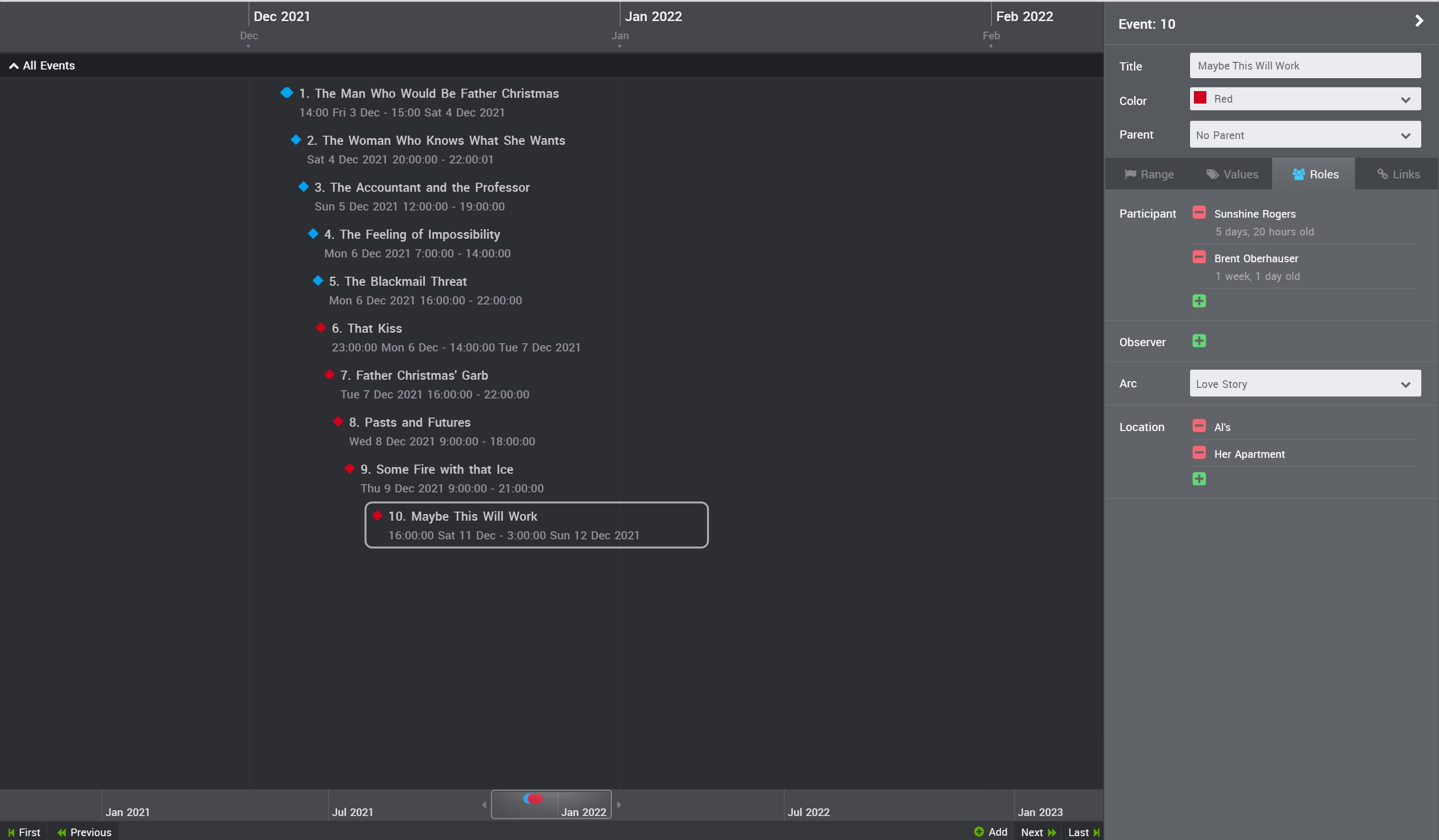
Here is a screenshot of my current project:
On the left, you can see the timeline. In my case, it’s color-coded to match a template I have for romance writing. On the right, you can see an event (the one highlighted on the left). On the event side, you can see at the top the event data — title, color, and parent. I do not use ‘parent’ because it ties everything to a preceding event and my mind doesn’t function that way. Below that to the right there’s data such as participants and observers, story arc, and location. Those are used as sorting prompts, and I haven’t found myself gravitating toward that function yet.
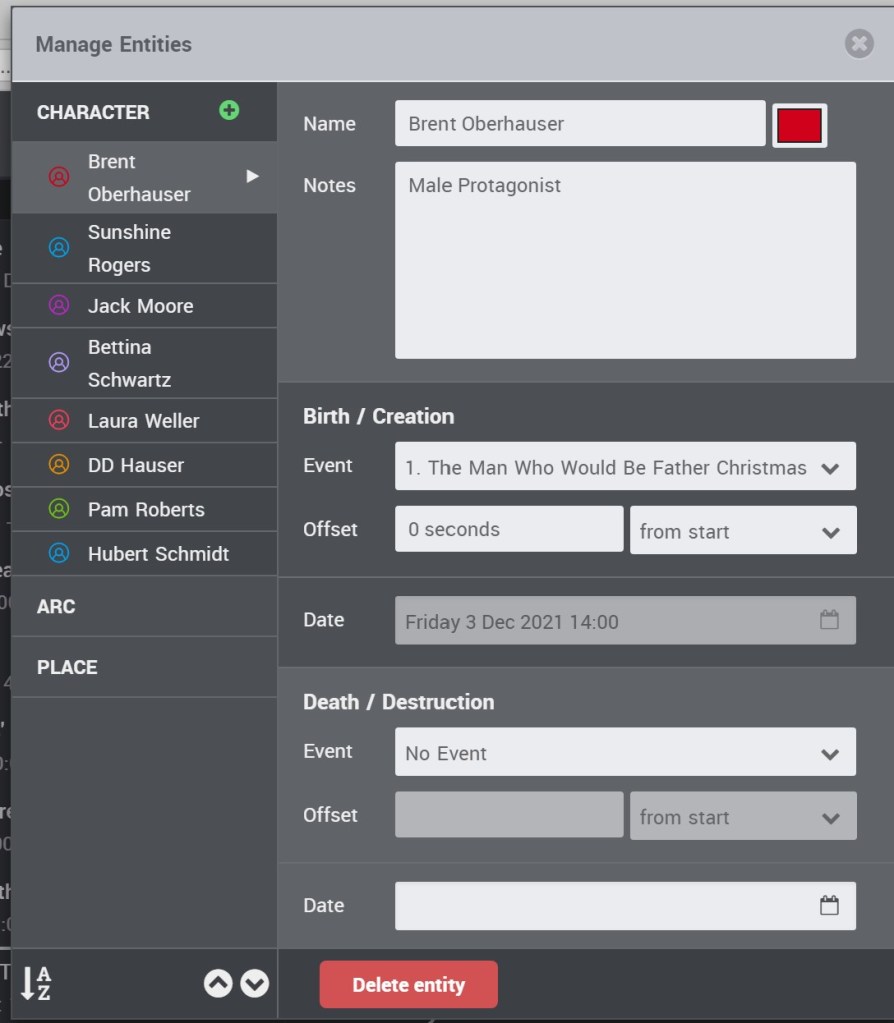
Below is what the ‘entity’ window looks like:
This is the ‘manage entity’ window. You can add entities here (to add anywhere, click a ‘plus’ button) and edit them. I recommend using this box rather than the ‘add entity’ box because you can manage things better here. Note on the left the window will also let you define story arcs and enter different places.
Notice I don’t use the birth/death blanks because I’m not writing epic fantasy. If I ever make the unified timeline for all my novels, I could use that. (But it would be an unwieldy timeline spanning 6000 years.)
The good thing about Aeon Timeline (to me) is that I can see that timeline, and in making it, I can ‘feel’ that timeline. I often make it after writing the book in my proofreading stage. This is probably the wrong way to use it. If I set it up before, I could actually import it into Scrivener (my writing software) and the timeline would show up. Somewhere. I have to try that.
The bad thing about this is all the data entry. I feel possessed to put in all the entity data and use all the categories when developing the event, and this can be a lot of work. Being a plantser (planner/pantser) writer, I don’t know that I would know all the events before using this tool such that I could use it at the beginning. I would advise to enter what is needed and leave the other bells and whistles alone.
I’m halfway through entering my Christmas romance for the year, Kringle in the Night, as I edit it one more time to make it ready for the Christmas season. It’s helping greatly. I’ll let you know about the Scrivener integration later.
My horoscope says my brain is worth of chatter. It is, if what you mean by chatter is “I really should doing this/that/the other thing” instead of coming up with any sort of new story ideas. And to some extent it’s right, given that I have an important assignment to grade, two interns to visit and two classes to prep for tomorrow. I will be busy today.
But I will manage some time for — what? I have to come up with an idea for Camp NaNo in April. Camp NaNo is like the training wheels version of NaNoWriMo — you can set a minimum of 10k words for a goal, there’s a lot more acceptance of doing something other than a novel during this time — it’s overall just a good warmup to a major project.
I have some back projects I could work on, if I can get engaged in them again. The main one is Gods’ Seeds, which deals not with gods per se, but the immortal Archetypes who have held societies’ cultural memories. The death of these memories will kill the people they represent. And now, as their leaders want to give cultural memory back to humans, a civil war between Archetype factions threatens widespread extinction across the Earth. One woman, one who touches mortality and the deity of the Archetypes, must realize her role and stop the immortals from fighting.
The other one would be fascinating, if I could spend six months in Krakow. This is not going to happen.
Part of my lack of ideas is this frustration with the idea of traditional publishing. I am beginning to consider self-publishing the rest of my catalog — fantasy and romantic fantasy, even as I struggle with the whole “your stuff will be considered better if you go through the gatekeepers.” It’s a big issue in the publishing industry, because self-publishing is confused with vanity publishing. But many famous authors started with self-publishing. I don’t think I will be famous, but I don’t want these books languishing in my computer files.
Or I could resubmit one of my works to another set of agents (or the same set of agents). That will take some work.
I don’t know what to do right now. Everything, anything, or nothing?
The cover blurb (if I get that far) for Gaia’s Hands:
Dr. Jeanne Beaumont’s life has escaped her logical, scientific notions – a seedling in her lab has grown into a monstrous vine, and a man half her age courts her.
Josh Young’s world of spirits and visions informs his writing but isolates him. Then in a vision of his current crush naked in a lush orchard of trees and vines, he realizes he wants more.
As Jeanne and Josh discover each other, pieces fall together: the vine’s lush growth, Josh’s visions, the attacks on Jeanne’s life’s work. What brought them together threatens to push them apart, unless they realize that things don’t have to be logical to be true.
I’m bad at writing book cover blurbs, and not that great at writing cover letter blurbs. It’s hard for me to find the essential pieces, keep the suspense in place, and communicate the gist of the book in as few words as possible. I’m lucky that this blurb only took two tries (but I thought the first, too long draft was perfect. Go figure.).
I might have learned something from this, however. Don’t repeat, don’t tell the whole story. I need to go over all my cover letters now and see if I can capture what I learned there. Wish me luck.







 Words Like Me